New York Stock Exchange Wrapped 2025
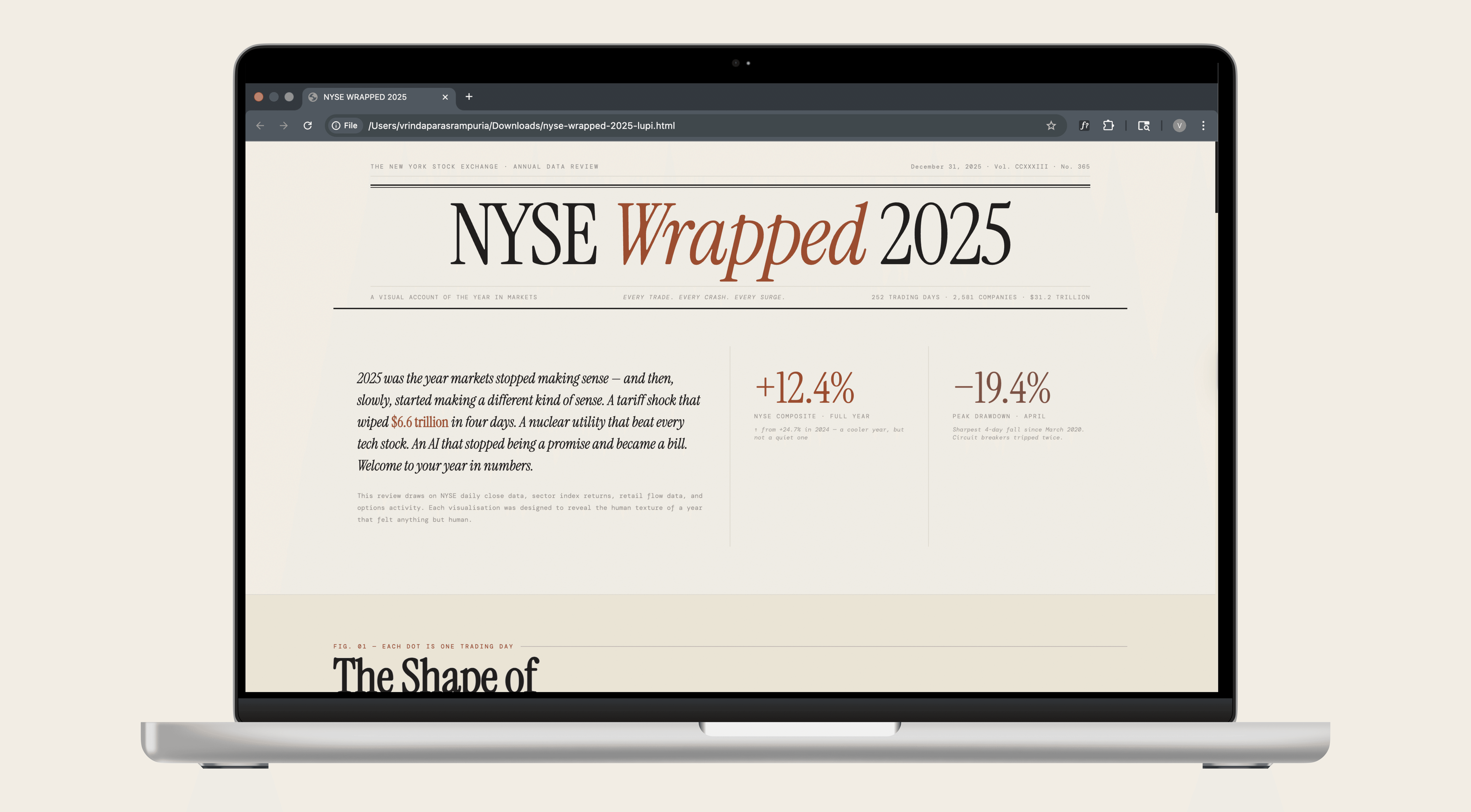
Annual market data is almost always presented in the same way, Bloomberg terminals, candlestick charts, and red and green tables. The challenge was to take a year of NYSE trading data and turn it into something people actually want to read: a publication, not a dashboard.
Year
2026
Industry
Finance
Conentration
Data Journalism, Editorial, Motion graphics
Duration
2 weeks
Problem
Financial data suffers from a design monoculture. Every tool uses the same visual grammar, dark backgrounds, neon green ticks, cluttered grids. This makes data legible to traders but alienating to everyone else. The opportunity was to ask: what if market data was treated with the same editorial care as a long-form piece in the New York Times?
Design Direction
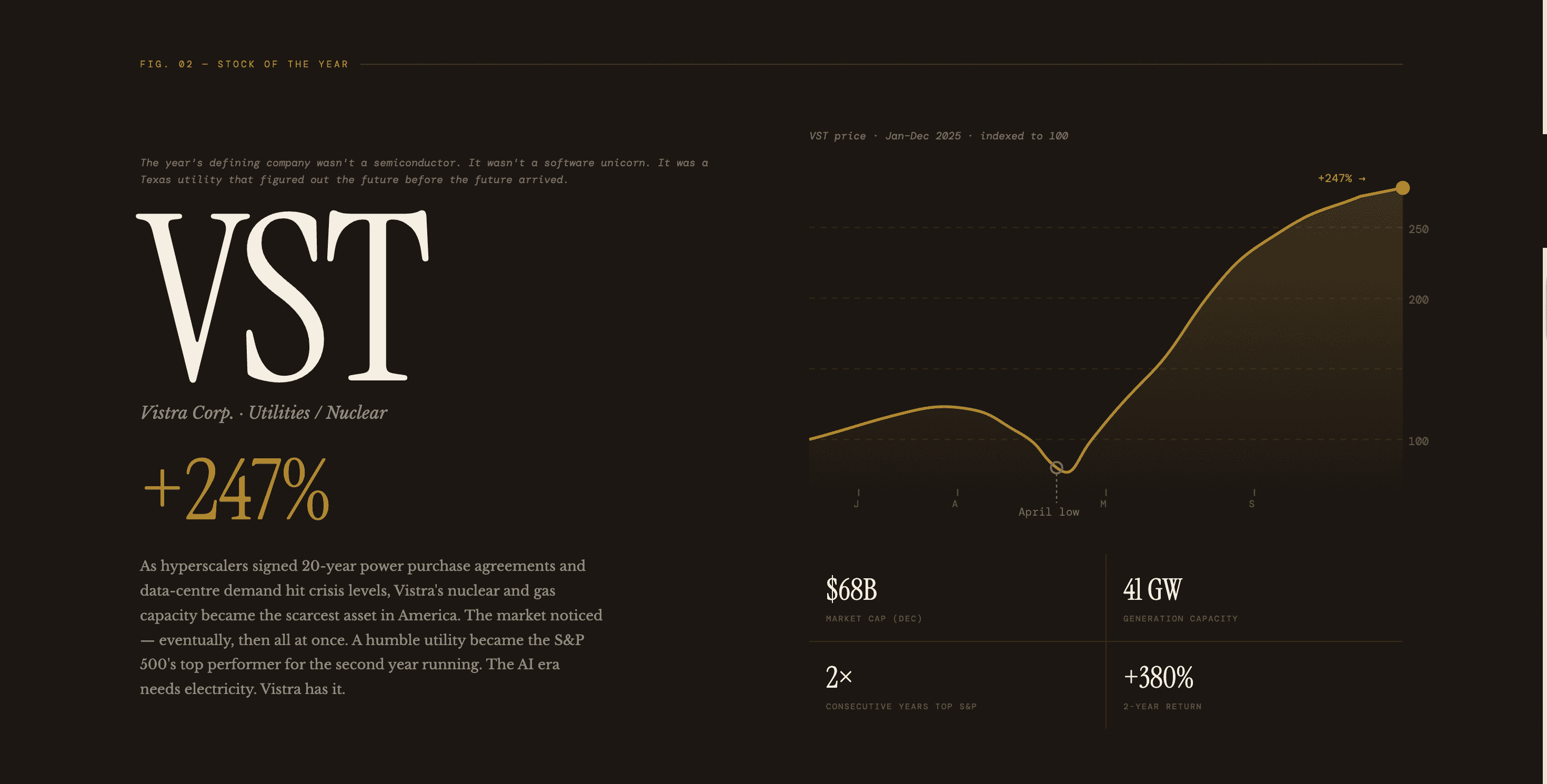
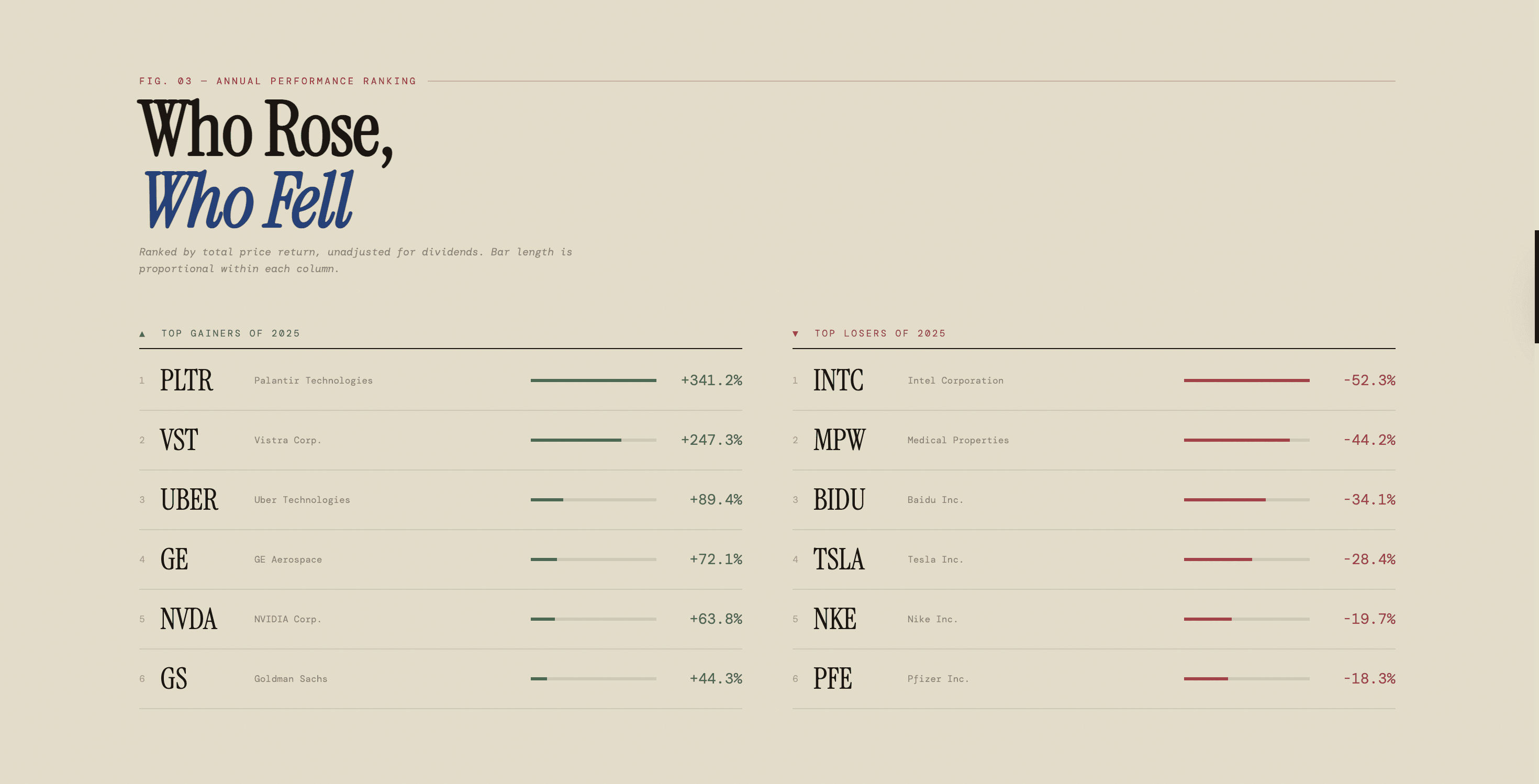
The visual language was built around two references: Giorgia Lupi's data humanism, the idea that data should feel personal, annotated, and human, and the NYT Graphics desk's tradition of giving each dataset its own bespoke visual form rather than reaching for a default chart type. Warm newsprint tones over dark dashboards. Serif typography over monospace data fonts. Every visualisation was designed specifically for its dataset, not adapted from a template.
Key Design Directions
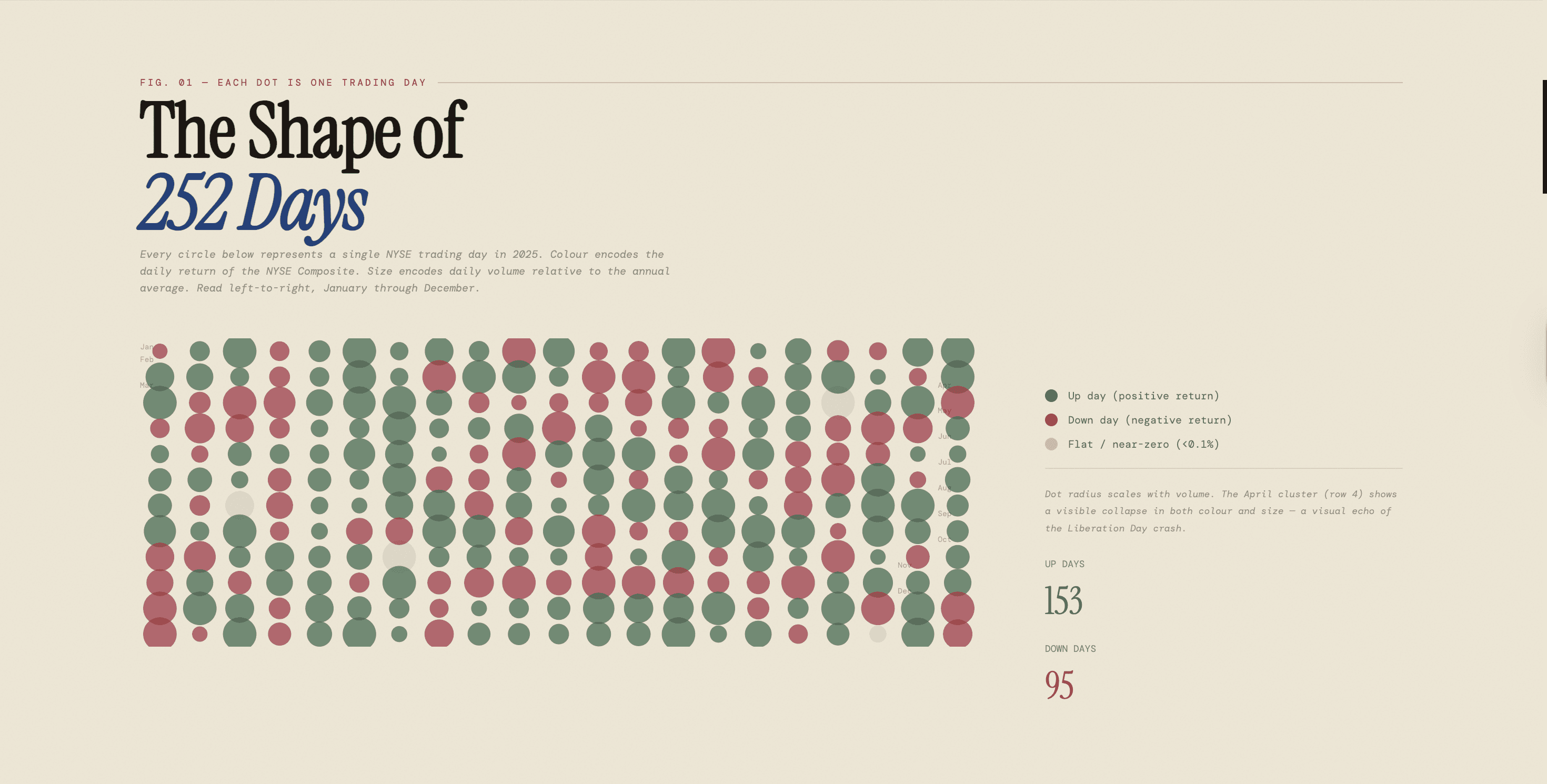
Dot matrix over line chart. 252 circles, one per trading day, where colour encodes direction and radius encodes volume. The April crash reads as a dense red cluster without a single label.
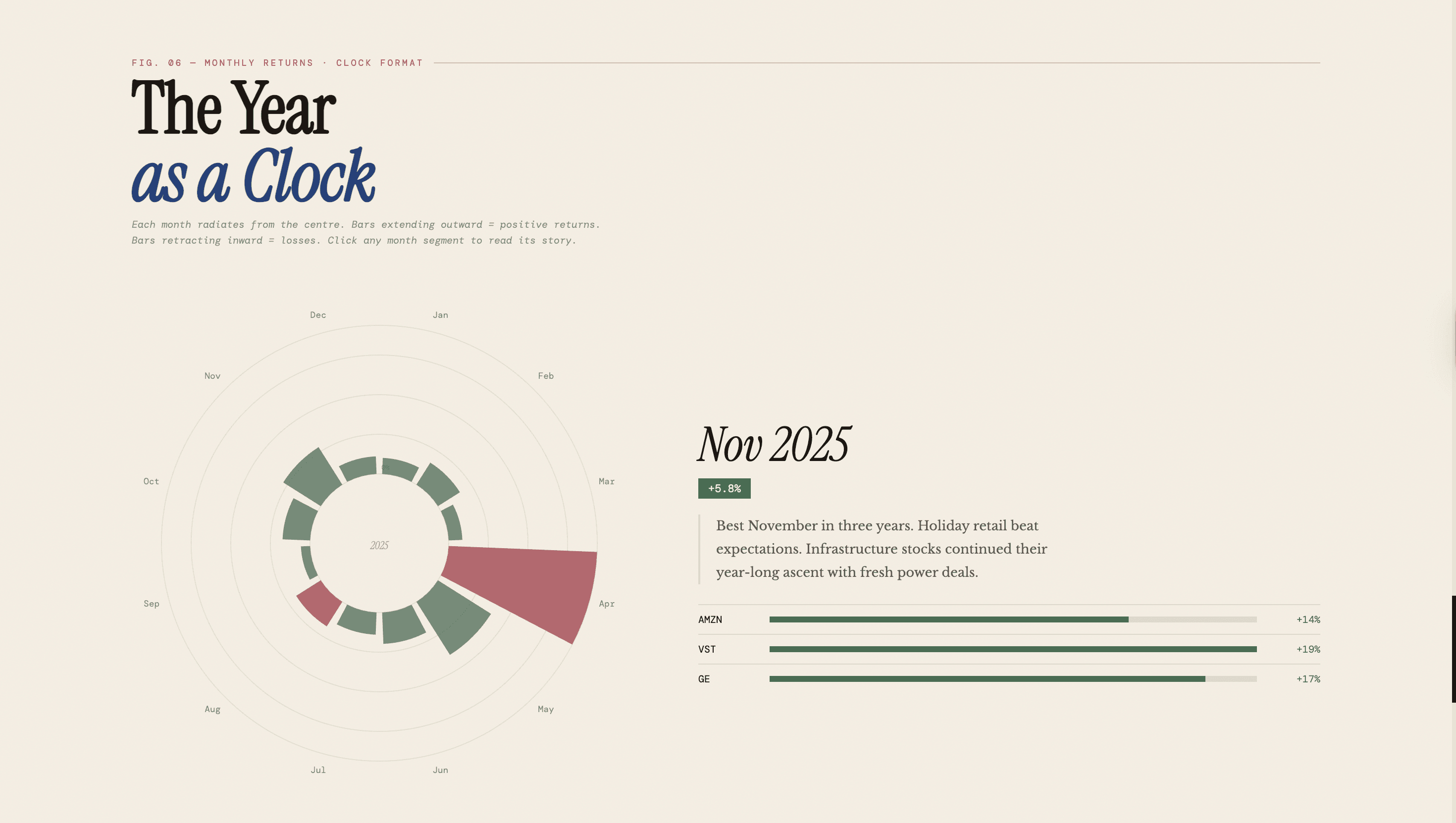
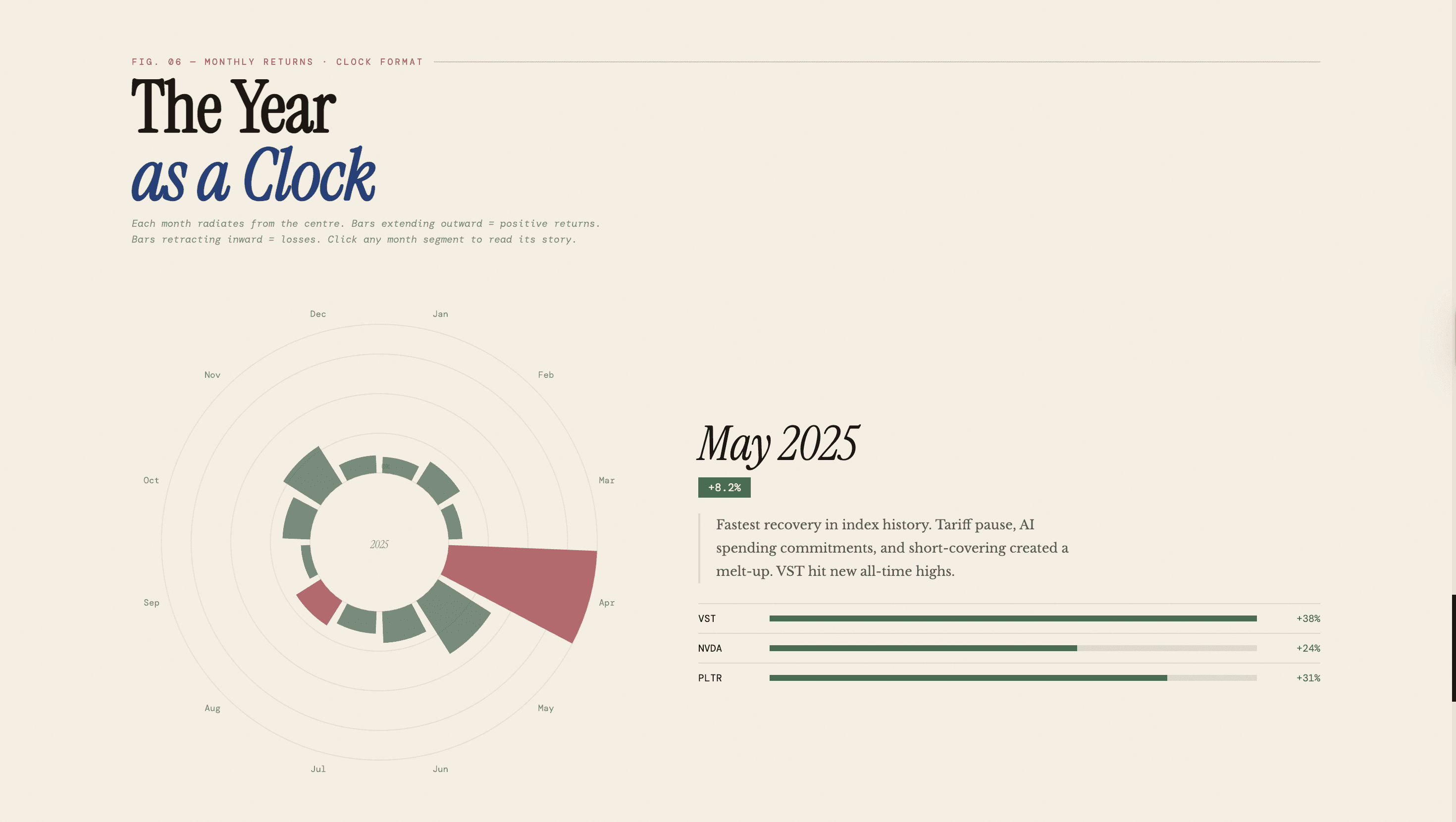
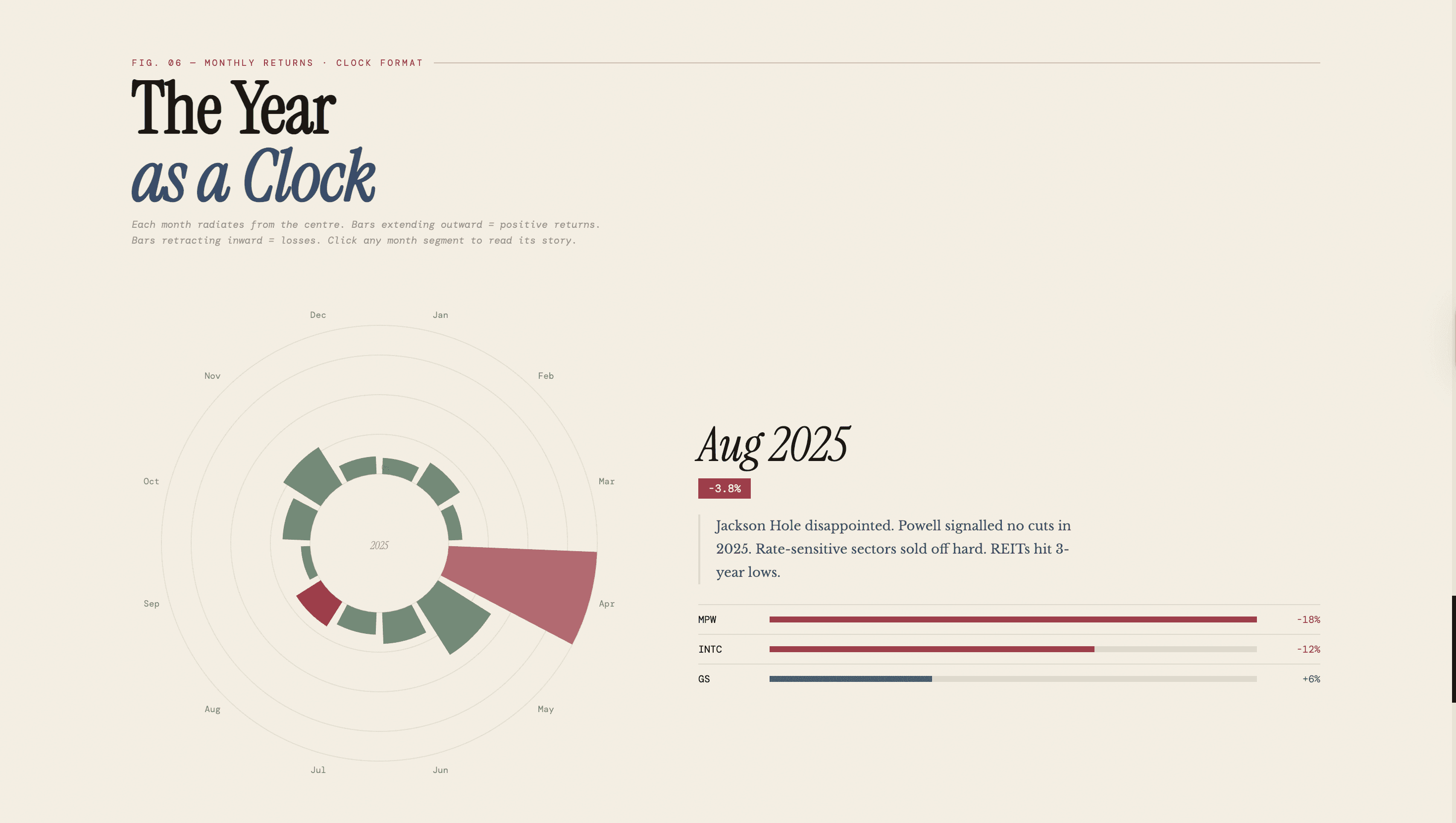
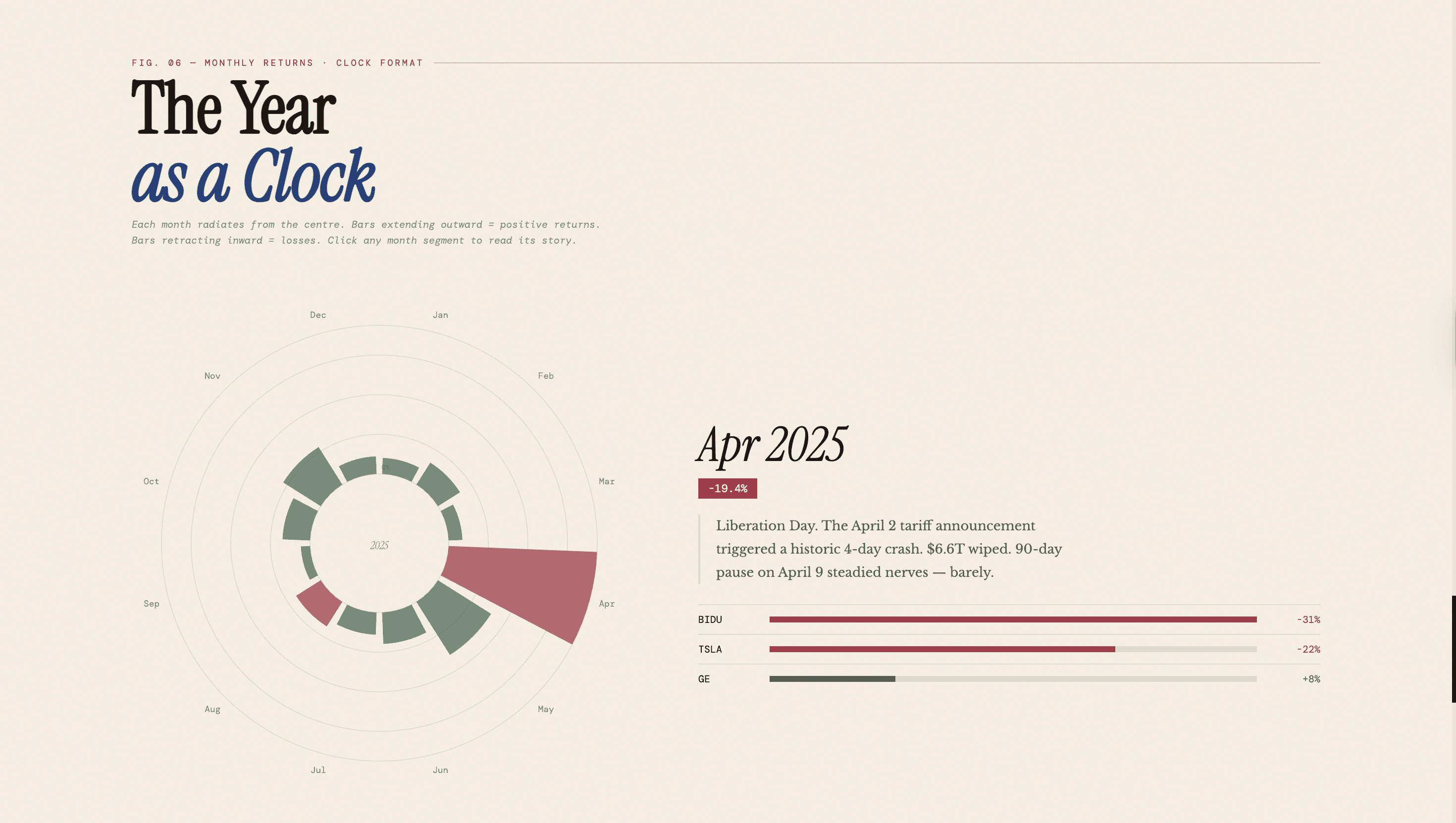
Radial clock for monthly performance. Twelve arcs radiating from centre, length proportional to return. The rhythm of the year, violent April contraction, May surge, readable in one glance. Click any arc to read the month's story.
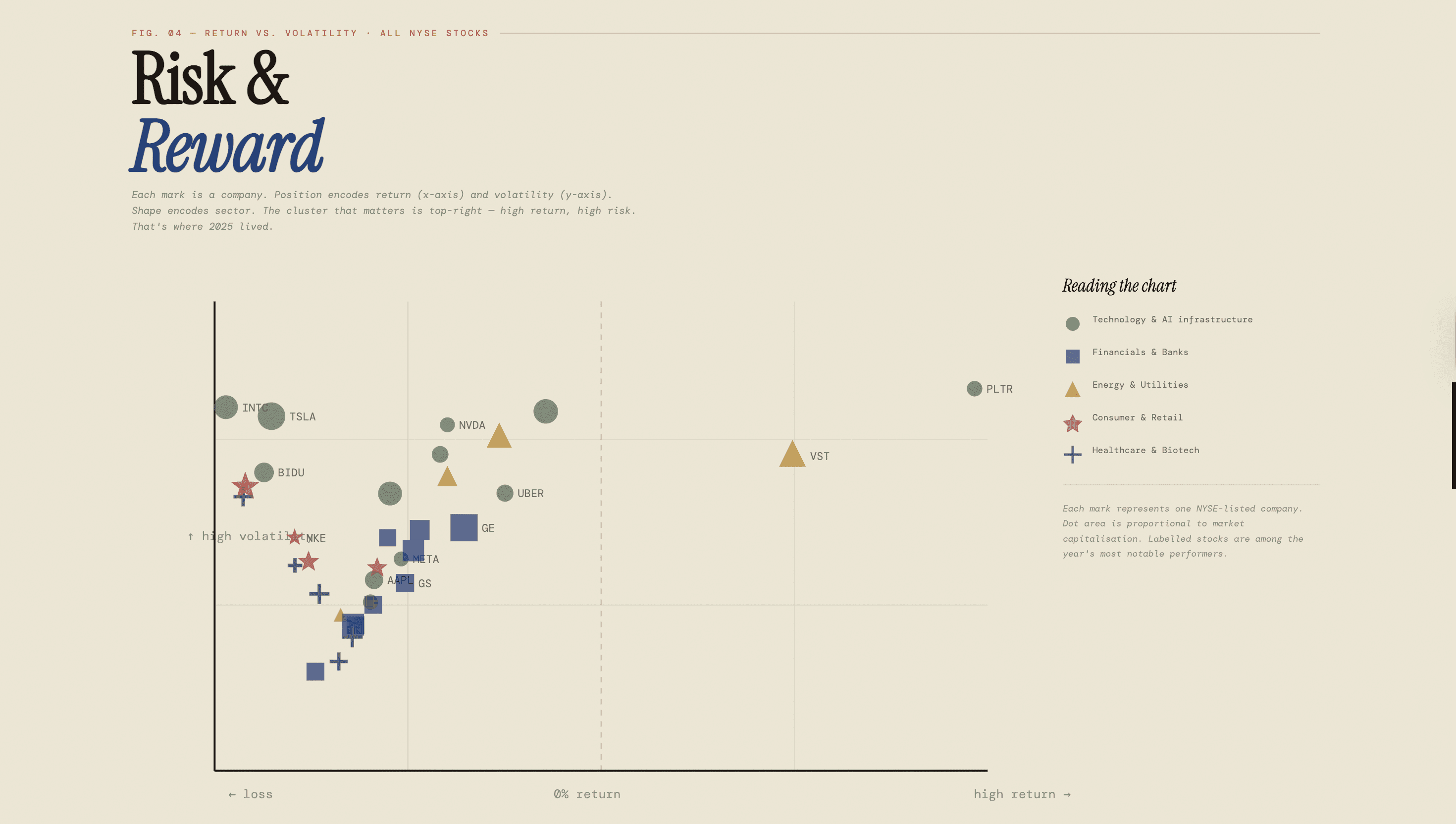
Shape-encoded scatter. Return vs. volatility for the full NYSE universe. Each sector gets a distinct geometric mark, circle, square, triangle, star, cross, inspired by Lupi's Dear Data: the shape is the legend.
Newspaper masthead as interface frame. Volume numbers, date lines, double-rule headers. The format signals journalism, not product, before the first chart appears.
Outcome
A self-contained, scroll-driven editorial experience that treats market data as a human story rather than a performance readout. Each section functions both as a standalone data poster and as a chapter in a year-long narrative — from the January optimism through the April collapse, the summer stall, and the year-end resolution.
Stack
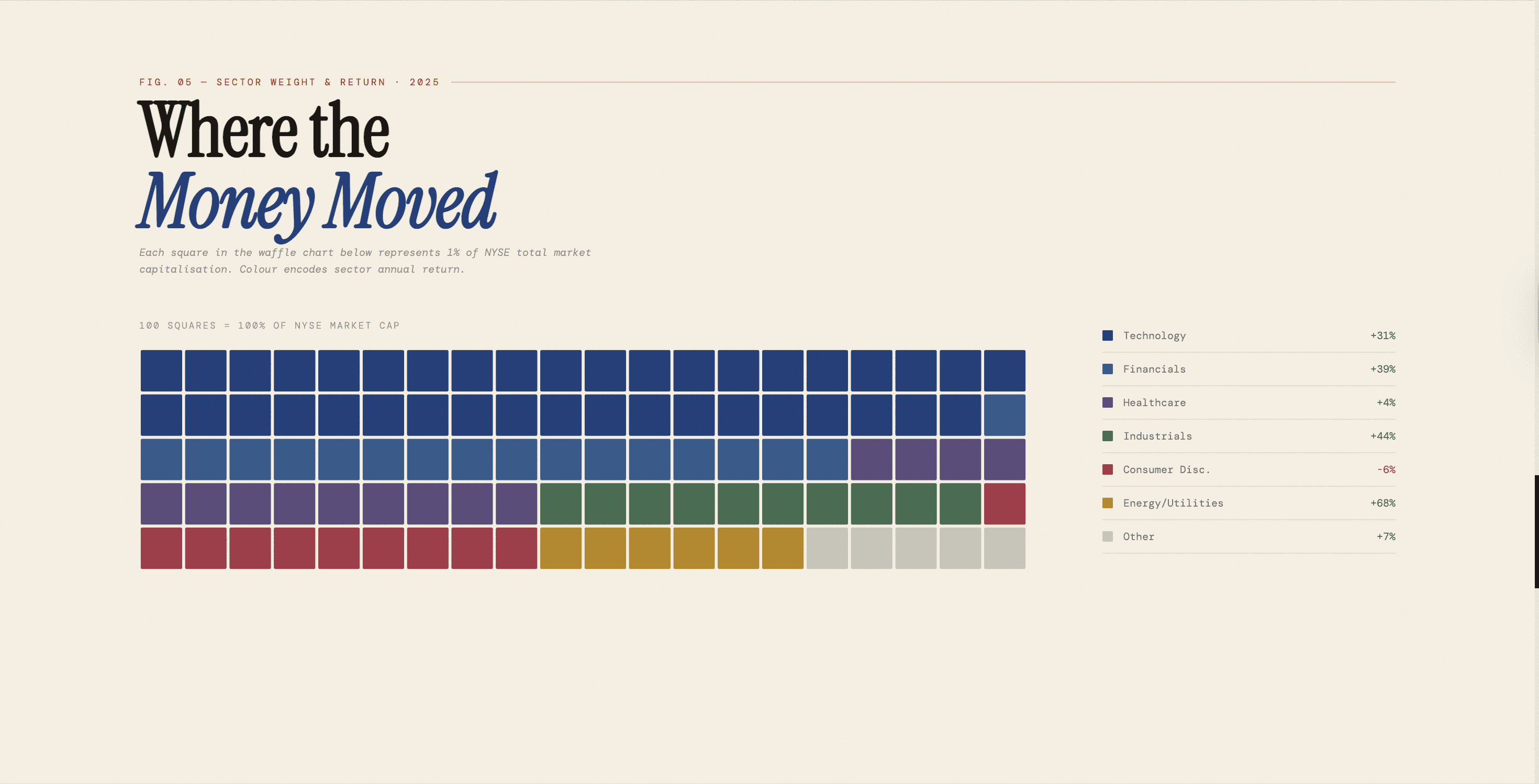
Vanilla HTML, CSS, and JavaScript. No frameworks, no chart libraries. Every visualisation is hand-coded SVG, which allowED precise control over every mark, annotation, and interaction. The dot matrix, radial clock, scatter plot, and waffle chart are all original constructions, not Highcharts, not D3 templates.
API use
OpenAI
Next Project