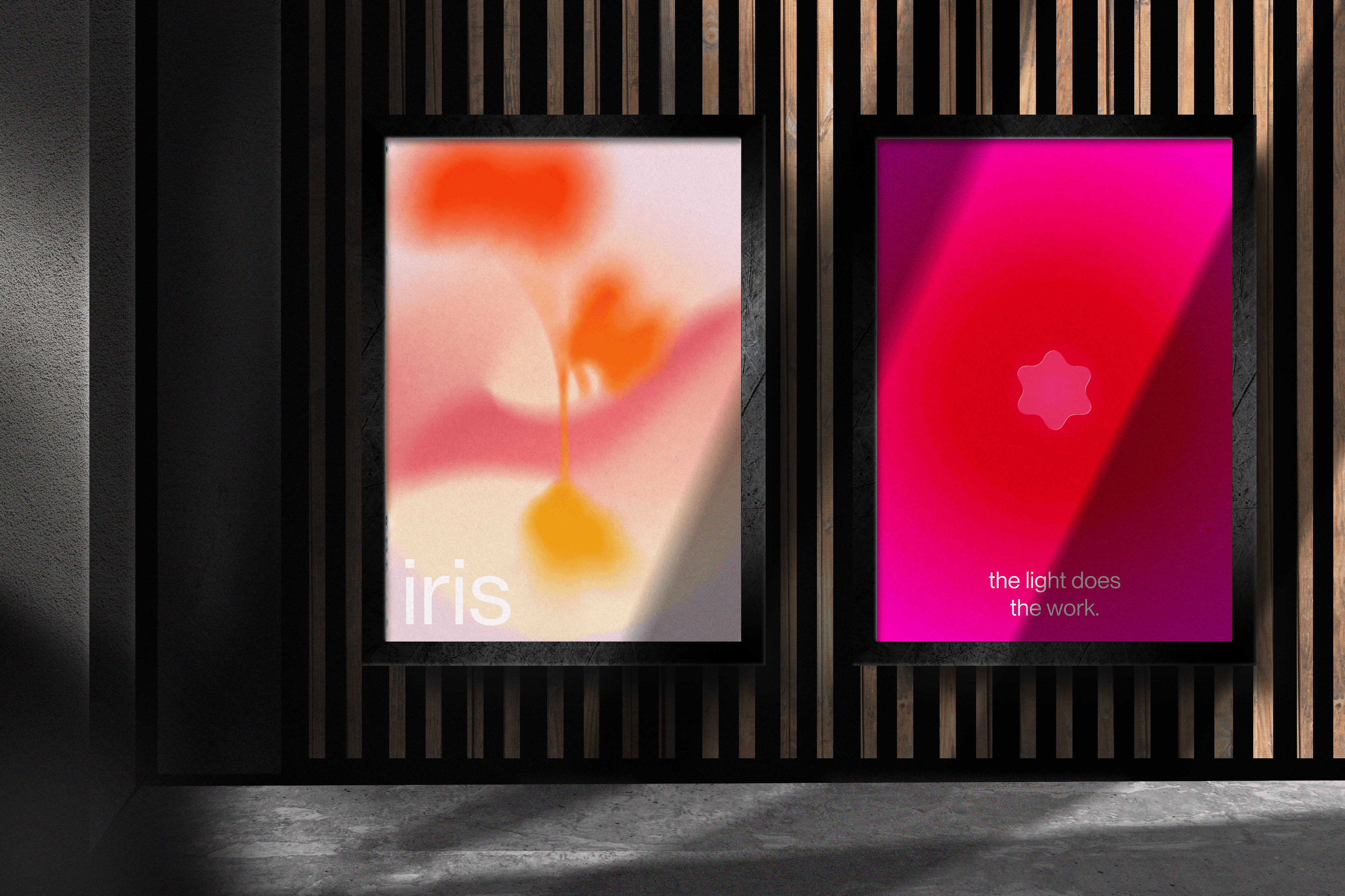
Iris (wip)
What if your mental health app
felt like stepping into a Turrell?
Iris is a voice-first conversational wellness platform that turns emotional check-ins into sensory experiences. Inspired by James Turrell’s immersive light installations, Iris uses gentle voice prompts and slow-moving color fields to help users notice what they feel without reducing it to a score.
The conversational UX is intentionally minimal. Iris does not analyze, coach, or over-explain. It asks short questions, gives space for silence, and lets color become the interface.
Instead of making mental health feel like another productivity task, Iris creates a quiet voice-led environment where the user can pause, breathe, and return to themselves.
Role
Branding, UX Research, Product Design, Prototyping
Type
Product Concept
Focus
Personalization, Product Design, Visual Identity
The problem
Most wellness apps are productivity software in disguise, streaks, badges, completion rings, mood scores.
Wellness apps often ask users to measure, track, and optimize their emotions.
But when someone feels anxious, overwhelmed, or scattered, being asked to complete another check-in can feel like pressure. The interface meant to calm them can start to feel like another thing they are failing at.
Iris asks:
What if mental health support did not feel like self-improvement software?
Core insight
The most effective mental health interface might be one you barely interact with
Instead of turning emotion into data, Iris treats emotion as atmosphere. Inspired by James Turrell’s use of light and perceptual space, Iris explores how color, silence, pacing, and voice can create a sense of emotional containment.
The user does not need to complete a task.
They need to be held by the experience long enough for something to soften.
Solution
Iris is a voice-first conversational wellness platform that replaces dashboards and mood tracking with slow, sensory interaction.
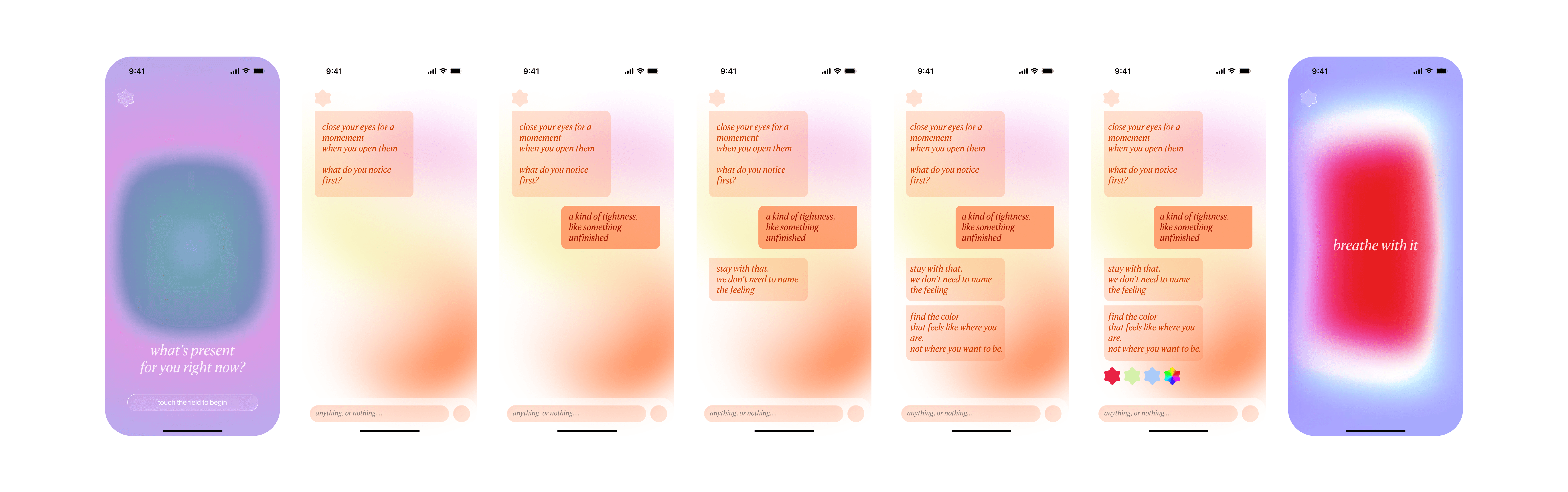
The app opens with a luminous color field and a simple voice prompt:
“What’s present for you right now?”
From there, Iris guides the user through a short, spacious exchange. The user can speak, type, pause, or say nothing. Instead of analyzing their response, Iris helps them stay with the feeling through gentle prompts and color-based interaction.
A selected color becomes the emotional seed of the session, slowly transforming into a full-screen breathing field. The interface becomes less like an app and more like a room made of light.
Final Design
Conversational UX Design
The conversational UX in Iris is intentionally quiet.
Iris does not behave like a chatbot, therapist, coach, or productivity assistant. It does not over-explain, diagnose, summarize, or try to “solve” the user. Its role is to create a calm emotional container through short prompts, silence, and slow pacing.
The voice system is designed around three principles:
01
Minimal prompting
Iris asks only what is needed. Questions are short, open-ended, and sensory.
“What do you notice first?”
“Where does it sit in the body?”
“Can you find the color of it?”
02
Permission to pause
Silence is treated as part of the interaction, not a failure state. The user is never rushed to answer.
They can speak, type, breathe, or simply stay with the field.
03
Reflection without analysis
At the end, Iris offers a soft closing reflection, not a clinical summary.
“You arrived scattered.
The light moved with you.
Something settled.”
The conversation is not designed to extract information.
It is designed to slow the user down.
Design Value
Iris reframes conversational AI for mental health as something slower, softer, and more atmospheric.
It shows how a voice platform can support emotional regulation without relying on productivity mechanics. Instead of extracting information from the user, Iris creates a space where the user can arrive, breathe, and leave with slightly less weight than they came in with.
More coming soon!!